Engineering the Future: Why Leadership Development Must Start Before the Boardroom
As a leadership coach and consultant working predominantly with senior leaders in STEM-driven, male-dominated industries — construction, engineering, biotech, and manufacturing — I spend my time with some of the most intelligent, capable and high-performing individuals in the UK and beyond.
These are leaders who are technically exceptional, commercially astute and operationally tested.
And yet, even at board level, I consistently observe the same pattern:
Brilliance without deeply embedded curiosity
Expertise without adaptive thinking
Authority without emotional regulation
Success without systemic imagination
The issue is not capability.
The issue is preparation.
And preparation begins long before someone reaches the boardroom.
The Education Model Is Designed for a World That No Longer Exists
In Mastery, Tony Wagner argues that our education system is outdated for the realities of the modern economy. He highlights that long-term success depends less on content knowledge and more on:
Critical thinking
Curiosity
Problem-solving
Collaboration
Agility
Initiative
Yet our education system still largely rewards:
Memorisation
Standardised performance
Compliance
Risk avoidance
We are preparing students for predictability in a world defined by volatility.
The future of work — particularly in STEM and AI-driven industries — demands:
Complex systems thinking
Ethical reasoning
Human judgment alongside machine intelligence
Resilience under uncertainty
These are not simply workplace skills.
They are leadership capabilities.
And they must begin in school.
The Brain Window We Are Missing
As a neuroscience-informed coach, I know something critically important:
When we are young, our brains are more plastic, more adaptive, and more open to rewiring.
During school years, students typically have:
Fewer identity constraints
Fewer career pressures
Less fear of failure
Greater cognitive flexibility
This is the optimal window to strengthen curiosity, imagination, and problem-solving capacity deliberately.
Instead, we overload students with content — and underinvest in development.
By the time leaders reach senior positions, organisations are attempting to retrofit capabilities that could have been cultivated 20 years earlier.
That approach is inefficient, costly, and often incomplete.
The STEM & AI Gap Is Not Just a Skills Gap — It Is a Development Gap
The UK continues to face:
Persistent STEM workforce shortages
Underrepresentation of women and disadvantaged groups in technical sectors
Skills mismatches between education and employer needs
Rising demand for AI literacy across industries
Employers consistently report that soft skills gaps appear as frequently as technical deficiencies.
The solution is not simply “more STEM.”
It is:
STEM + AI + Personal Development.
We must develop not only technical competence but also:
Adaptive thinking
Emotional regulation
Communication
Ethical decision-making
Creative confidence
Because while AI will handle data, humans must handle complexity.
Future-Ready Requires System Collaboration
Education cannot solve this alone.
Industry cannot complain without engaging.
Policy cannot be designed without lived insight.
We need a structural partnership between:
Schools and teachers
Universities and colleges
Industry leaders and boards
Policy makers
Parents
Community organisations
Not in isolation.
Not in token advisory roles.
But in active collaboration.
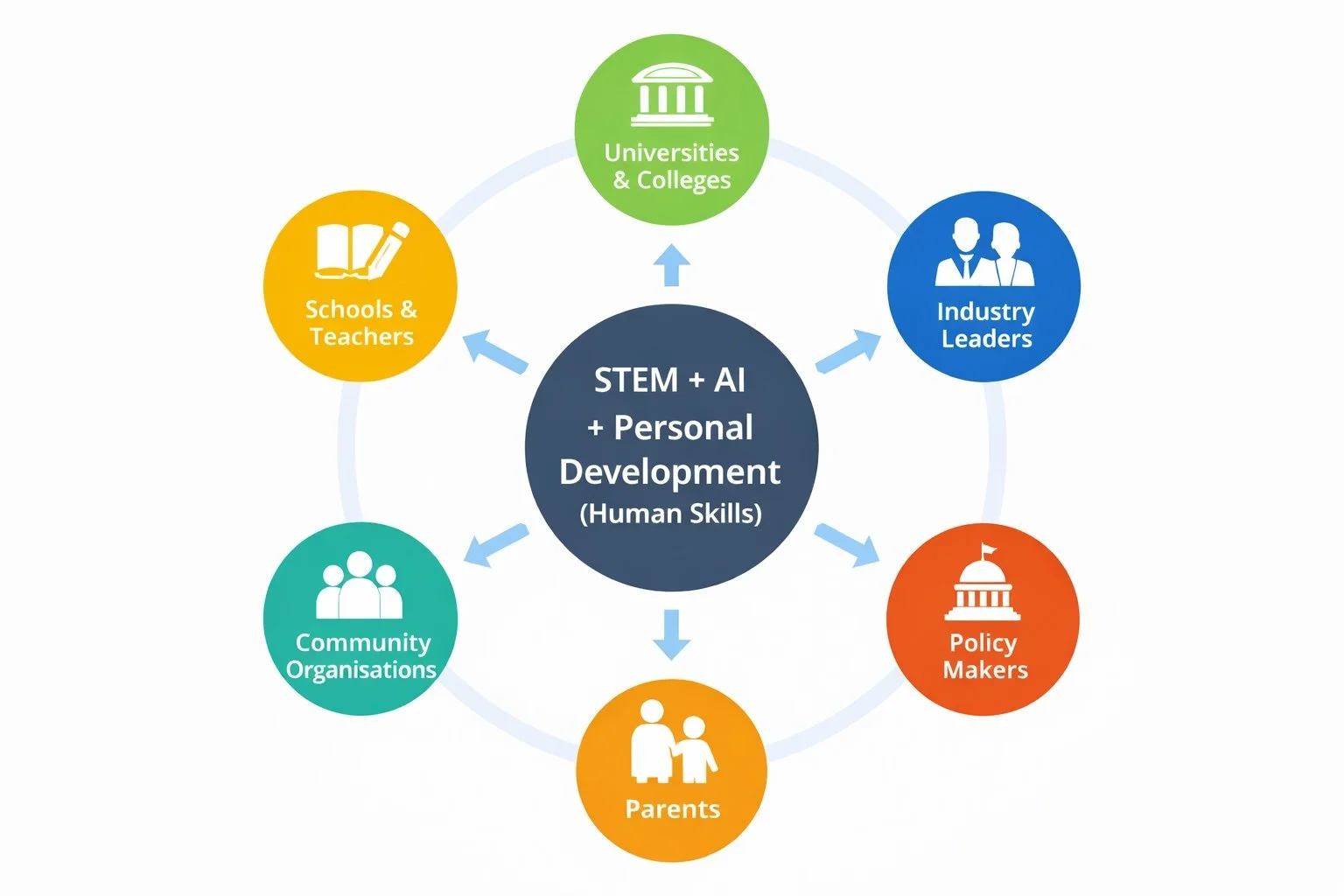
Engineering Future Talent Through Collaboration
Industry must:
Share real-world challenges with schools
Co-design exposure pathways
Offer enrichment and mentoring
Contribute to curriculum conversations
Education must:
Integrate meaningful AI literacy
Develop problem-based learning
Invest in socio-emotional development
Strengthen inquiry and imagination
Parents must:
Encourage curiosity beyond grades
Normalise experimentation
Support long-term growth over short-term results
This Is About Social Mobility and Talent Preservation
If we fail to broaden access to STEM and leadership development early, we will continue losing talent before it reaches industry.
There is a widening gap between students who access enrichment and those who do not.
This is not just an education issue.
It is an economic risk.
If we want:
Diverse leadership pipelines
Inclusive technical sectors
Sustainable AI adoption
Stronger national productivity
We must invest earlier — and more intelligently.
Engineering the Future Together
Through my work at Engineered Life by Design, one truth has become clear:
The leadership challenges we see in boardrooms are often echoes of developmental gaps from decades earlier.
If we want:
Leaders who think clearly under pressure
Teams that collaborate across disciplines
Organisations that innovate ethically
Cultures that balance performance with humanity
Then we must begin before job titles are formed.
Future-ready is not about coding alone.
It is about curiosity.
It is about problem-solving.
It is about imagination.
It is about developing humans who can navigate complexity — with intelligence and integrity.
I am actively seeking collaboration with:
Industry leaders
Education providers
Career hubs
Policy influencers
Social mobility advocates
AI and STEM organisations
If you believe we must rethink how we prepare the next generation — not just for employment, but for leadership — I would welcome a conversation.
Together, we can:
Close talent gaps
Strengthen social mobility
Align education with future realities
Build a truly future-ready generation
The future is not something we inherit.
It is something we engineer.
With gratitude and purpose,
Dr Susan Izadkhasti
Founder & CEO
Engineered Life by Design
